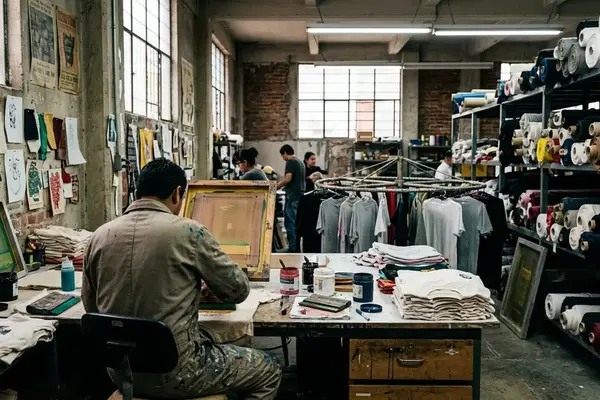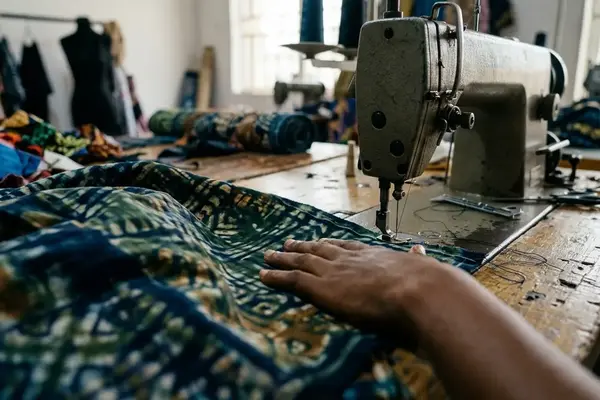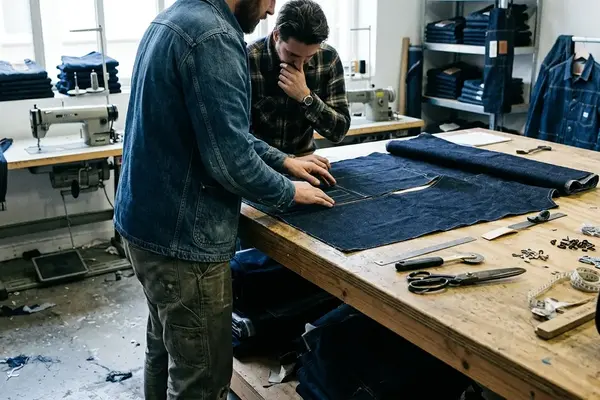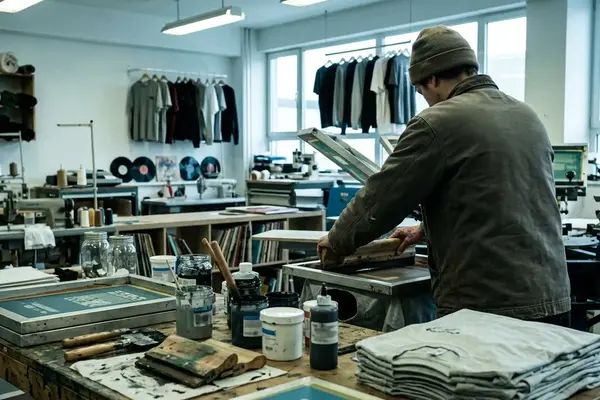
Seoul menswear does not move quickly because designers have discovered a secret factory. It moves quickly because Dongdaemun compresses the awkward gaps between fabric merchant, pattern room, cutting table, sewing floor and showroom.
That distinction matters. The district was built to shift volume, yet smaller labels now use the same machinery to test silhouette, styling and demand in tightly controlled runs. The result is a production culture where an oversized shoulder can travel from reference image to sales floor while a conventional sourcing chain is still arranging its first development call.
In this Article
- The Evolution of Dongdaemun Wholesale
- Mechanics of the Midnight Supply Chain
- Trend Velocity and the Styling Advantage
- Spatial Curation in Café Retail
- Global E-Commerce Infrastructure
- Navigating the Pipeline for a Capsule Release
The Evolution of Dongdaemun Wholesale
A major garment market opened beside Cheonggyecheon in 1961. Cloth dealers gathered around it, followed by cutters, sewing rooms and the supporting trades that make garments commercially repeatable. During the 1990s, multi-level wholesale complexes expanded this showroom-and-factory network.
Dongdaemun became fast through accumulation, not one clean modernization campaign. Fabric, rib, zippers, labels, patterns, cutting and sewing could all be coordinated across Dongdaemun, Jongno and adjacent Sindang. Development work no longer had to disappear into a distant industrial region before returning as a finished sample.
Handoff Density Beats Simple Proximity
The useful measure is handoff density. Cloth can leave a merchant, reach a pattern room, move to a cutting table and land on a sewing floor through same-district couriers. Each short transfer removes an opportunity for an email to sit unanswered or a parcel to miss a dispatch.
This infrastructure originally favored volume. Contemporary menswear labels have repurposed it for agility: smaller runs, rapid corrections and production decisions made closer to the moment of sale. It is the industrial equivalent of sampling an old record rather than composing with a blank score.
Key Takeaway: Dongdaemun's advantage is not a single high-speed supplier. It is the concentration of ordinary specialists who already know how to pass work between one another.
Mechanics of the Midnight Supply Chain
By late afternoon, showrooms are arranging samples and preparing order books. From roughly 8 PM, domestic buyers and overseas buying agents inspect garments, photograph details and place orders. Core activity continues until around 5 AM, although schedules differ by building and floor.
Couriers turn those decisions into movement. Overnight orders are sorted and dispatched in the pre-dawn window, ready for retail buyers to receive or forward after the market closes. The night market is not theatre for tourists. It is a working interface between design, wholesale and logistics.
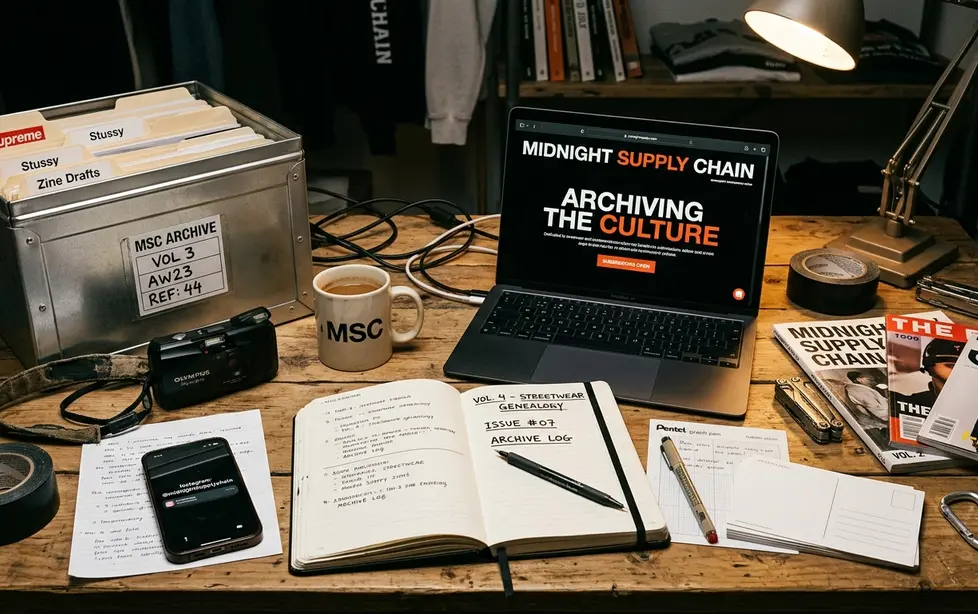
What a Sub-72-Hour Sample Requires
A fast sample begins with a complete handoff: reference garment, measurement sheet, shell cloth, rib and trims. If any one of those pieces arrives late, geographic closeness stops being useful. Queue time still changes with the workshop order book, holiday calendar, fabric availability and the schedule of the particular floor.
The sub-72-hour claim is most credible for familiar cut-and-sew constructions in jersey, cotton fleece and standard synthetics. Canvassed tailoring, bonded seams, custom membranes and proprietary hardware return the calendar to multi-stage development and testing. Wool flannel suiting cannot be treated like a basic sweatshirt merely because both workshops share a postcode.
Warning: Speed does not repair an incomplete specification. A rushed sample can look convincing while hiding unresolved shrinkage, trim or construction decisions.
Trend Velocity and the Styling Advantage
Dongdaemun lets brands place more creative attention on proportion than on inventing a textile platform from zero. A familiar material becomes the base; shoulder extension, body width, sleeve pitch, hood volume, hem tension and trouser break become the design argument.
This is why the lookbook carries unusual weight. Casting, location and layering tell the customer how a garment belongs in the world. The lesson is visible well beyond Seoul: Mitchell & Ness can signal sporting memory through recognizable forms, while an FC St. Pauli reference can load a plain piece with terrace politics and subcultural affiliation. Construction matters, but context decides how it reads.
From Sample to Sellout
A label releases a micro-batch and takes its first useful read during the opening 24 to 48 hours. Paid orders sit above softer signals such as saves and sizing questions. Reorders are then judged by SKU and size, not by the apparent popularity of the whole image.
That distinction prevents a common mistake. High engagement may belong to the casting, location or outer layer rather than the sweatshirt being measured. A popular photograph can conceal weak garment demand.
When a SKU earns a repeat, the approved pattern, graded size nest, marker and sewing specification remain in place. Production can restart without rebuilding development from the beginning. The real asset is not virality; it is a reusable technical record attached to a legible demand signal.
Spatial Curation in Café Retail
A customer enters for coffee in Seongsu-dong, takes a seat beside an exposed column, then notices a garment rail beyond the communal table. The mirror and fitting area sit deeper in the room. One payment point closes both journeys.
That sequence makes retail feel discovered rather than imposed. It also gives a digitally led brand a physical place where customers can inspect fleece backing, rib recovery, garment weight and wash treatment, qualities that compressed social video rarely communicates reliably.
Hannam and Seongsu Send Different Signals
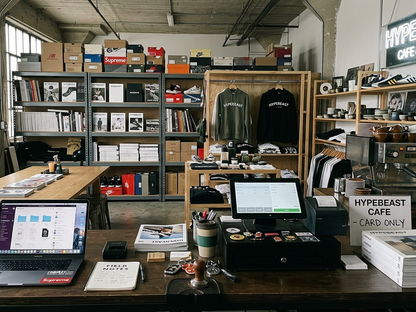
Seongsu spaces often retain workshop cues: unfinished masonry, loading access and exposed structural elements. The setting connects new clothing to a visible industrial shell. Hannam-dong tends toward compact destination storefronts embedded in mixed residential and commercial streets, within a more polished circuit of galleries, restaurants and retail.
Neither neighborhood acts as a neutral backdrop. The room edits the brand before the customer touches a sleeve.
Pro Tip: Arrange the space around a sequence of use: coffee counter, seating, garment rail, mirror and shared checkout. Randomly placing clothes inside a café produces décor, not retail.
Global E-Commerce Infrastructure
International expansion begins with the product record, not the courier label. English garment names, fiber content, country of origin, measurements and care instructions need to agree across the product page, warehouse record and customs paperwork.
A customs-ready record includes composition, origin, unit value, currency, quantity, net weight and a plain-language garment description. A cotton knitted sweatshirt commonly begins classification analysis under HS heading 6110.20, but the final filing still depends on its actual construction and composition.
Local Fulfilment Without Flattening the Brand
A localized third-party logistics operation can hold stock, inject parcels into domestic carrier networks and receive returns locally. That avoids routing every unwanted size back to Seoul. For eligible European Union imported orders with an intrinsic value not exceeding €150, the Import One-Stop Shop can handle the relevant collection process.
The logistics layer should be dull, accurate and nearly invisible. The expressive work happens elsewhere: in the lookbook, silhouette and product language. Seoul brands can carry that aesthetic across borders because images already transmit proportion and styling without requiring the viewer to understand the district that produced them.
Yet imagery cannot compensate for a vague size chart or a careless customs description. The sharper the visual promise, the less tolerance the customer has for administrative friction.
Navigating the Pipeline for a Capsule Release
Consider a release of 50 heavyweight hoodies. The aim is not to flood a channel. It is to preserve enough control to fit, photograph, sell and potentially repeat one defined product.
Day 1: Source and Specify
- Write the purchase order precisely. State whether 50 means pieces cut or finished pieces accepted after quality control.
- Visit Dongdaemun Fabric Square during daytime market hours. Request 800 g/m² French terry cotton and compatible rib. Confirm the merchant's selling unit, usable width, face finish, loop structure and available dye lot before discussing yardage.
- Prepare the handoff pack. Include the reference, measurement sheet, shell fabric, rib and trims. Send the complete pack to a pattern maker in the Sindang-dong area.
- Set the first-sample target. The clock starts when the pattern maker has every component, with the physical sample due 48 hours later.
Day 3: Fit Before Committing
- Fit the sample as a garment, not a mood. Check shoulder extension, body width, sleeve pitch, hood volume and hem tension against the measurement sheet.
- Record corrections. Mark each change on the specification rather than relying on photographs or chat messages.
- Approve grading and marker planning. The marker calculates actual consumption from the size mix and usable fabric width. Add documented shrinkage and cutting allowance instead of guessing yardage from the 50-piece count.
Cut, Sew and Prepare the Drop
- Match sample and bulk inputs. Confirm the bulk cloth belongs to the intended dye lot and verify fleece shrinkage before cutting. A fast sample becomes useless when bulk fabric behaves differently.
- Release the approved marker to cutting. Keep the corrected pattern, graded size nest and sewing specification together as the production record.
- Photograph the approved sample while the micro-batch is sewn. Build the product page with the confirmed composition, measurements, origin, care details and customs-ready description.
- Launch all 50 finished hoodies by SKU and size. During the first 24 to 48 hours, separate paid orders from saves and sizing questions. If specific sizes earn a reorder, send the retained pattern, marker and sewing specification back through the same production chain.
The copyable pipeline is now complete: source 800 g/m² French terry on Day 1, deliver a complete Sindang handoff, fit the sample on Day 3, approve the marker, check shrinkage and dye lot, cut the 50-piece capsule, photograph the approved garment, then reorder only the sizes that customers actually buy.