In this Article
- The End of the Monolith
- London: Curated Nostalgia and the Casuals Revival
- Berlin: Industrial Grit and Utilitarian Function
- The Limits of the Geographic Binary
- Choosing a Lane in Contemporary Menswear
The End of the Monolith
The closure of London’s Hideout Store in early 2014 did not feel like routine retail churn. It removed a room. A meeting point. A place where buyers, kids, stylists, collectors, and the quietly obsessive could read each other’s signals at close range.
Streetwear rarely fractures first on the runway. It splits through the places where people buy, meet, wholesale, and argue over what counts. Hideout mattered because it helped hold European streetwear inside one shared conversation: Japanese imports, American sportswear, British terrace codes, skate product, and denim all passing through the same physical filter.
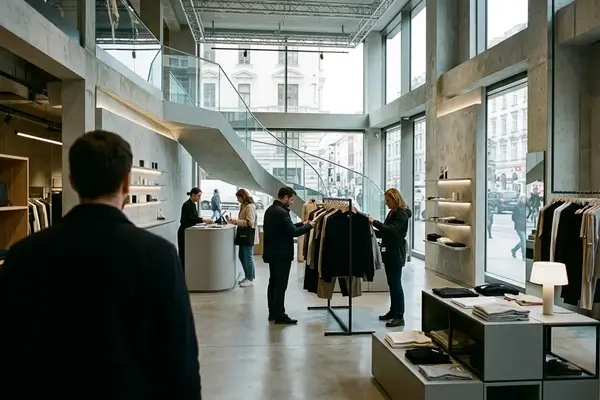
At almost the same moment, Berlin’s trade infrastructure was getting louder. Across the 2013-to-2015 menswear trade-show cycle, events like (capsule) Berlin made repurposed industrial venues part of the message. The Postbahnhof was not neutral scenery. Concrete, steel, exposed utility, and warehouse light shaped how the product was read.
That is the cleaner marker of the split. London lost a unifying retail node. Berlin gained a wholesale stage that made geography feel like an aesthetic position.

Why the split happened in shops before slogans
The monolith ended because the infrastructure changed. A city’s scene is not just its designers; it is the routes between stores, showrooms, hotels, clubs, and buying appointments. Once those routes separated, the clothes followed.
Key Takeaway: European menswear is no longer one narrative with local accents. It has split into two opposing philosophies: London builds authority through cultural memory, while Berlin builds it through material conviction.
London: Curated Nostalgia and the Casuals Revival
London’s contemporary streetwear language is built from return signals: terrace outerwear, 1990s silhouettes, checked coats, skate-shop irreverence, and the hotel-lobby clustering of launches, music-adjacent gatherings, and small stores. The reference pool runs mainly from late-1980s casualwear through mid-1990s British street and skate styling.
London Collections: Men gave that tendency a visible frame. The city did not abandon streetwear for tailoring or runway polish. It folded youth-culture memory into a sharper, more styled register.
The resurgence of the 1980s Casuals subculture is the key pressure point. Burberry nova-check does not read as simple heritage when it sits next to Palace. It becomes a class signal, a football signal, a mall-rat signal, and a skate signal at once. That collision is London’s move.
The archive is not neutral
Brands such as INDCSN and collaborations like Veras x Casual Connoisseur show how modern vintage works when the references are close enough to touch. The product can look familiar without becoming museum cosplay. Washed graphics, terrace proportions, worn-in colour combinations, and archival sportswear shapes carry the load.
Mitchell & Ness sits comfortably in this conversation because nostalgia is not a weakness here. It is raw material. The same goes for a track jacket, a checked overshirt, or a boxy fleece that seems to have been pulled from an older cousin’s wardrobe rather than invented in a product meeting.
East London intensified the effect in the early-to-mid 2010s. Hospitality spaces, brand launches, small stores, and music-adjacent gatherings started sharing the same postcode logic. The scene became less about a single destination and more about a circuit.
Warning: A label that borrows terrace nostalgia without lived cultural proximity can look like costume, especially when the styling depends on one obvious check, one retro sneaker shape, and no deeper reference system.
London’s advantage is speed of recognition. The clothes can trigger memory before the wearer has to explain them. That is powerful, but it is also unforgiving.
Berlin: Industrial Grit and Utilitarian Function
Berlin does not ask whether a jacket has the right nostalgic charge first. It asks what the fabric does, how the seam holds, how the pocket sits, and whether the garment improves after being knocked around.

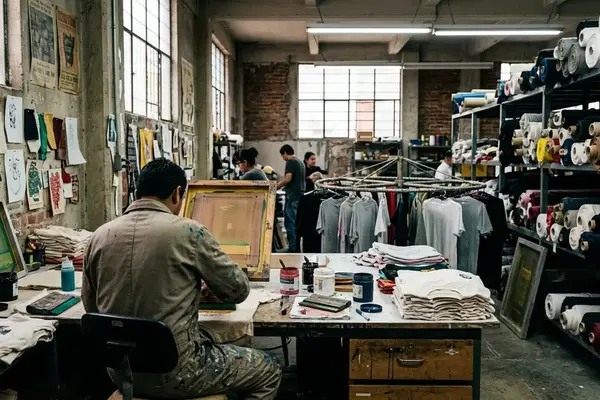
At (capsule) Berlin, especially inside repurposed spaces like the Postbahnhof, the setting sharpened the product rather than decorating it. Metal, wood, stripped-back display systems, and workshop language all pointed in the same direction: function before mythology.
The strongest material signals are blunt and tactile. Rigid selvage denim. Indigo-heavy palettes. Waxed or oiled surfaces. Dense cotton twills. Leather. Hardware that reads as useful rather than decorative.
Construction becomes the cultural code
Eat Dust and Edwin Europe’s Indigo Origins make sense in this frame because pure indigo blue selvage denim is not just a colour story. It is a commitment to ageing, stiffness, abrasion, and repetition. The garment earns its meaning through wear.
The Moving Development and collectives like Black Lodges sit close to motorcycle culture without turning every piece into costume. The better read is pattern logic: reinforced panels, practical closures, dense cloth, and silhouettes that assume movement rather than posing.
Supporting data confirms the useful timeframe: from roughly 2013 to 2016, utility styling moved from niche workwear corners into broader contemporary menswear edits. Berlin gave that shift a convincing stage because the city’s built environment already spoke the language.
A wool flannel overshirt in this context does not need a sentimental backstory. If the handle is right, the weight is right, and the cut sits clean over denim, the argument is already being made.
Pro Tip: If a Berlin-coded collection needs a paragraph of explanation for every pocket, the design has probably lost its nerve. Utility should be legible at arm’s length.
The Limits of the Geographic Binary
The Berlin versus London split is useful because it clarifies a real divergence. It also becomes lazy if treated like a border checkpoint.
Paris complicates the map. In neutral multi-brand retail environments, conflicting codes can sit on the same rail without collapsing into mush. A buyer can place high-end Raf Simons near commercial Vans, then let the edit do the translation. No single label has to carry luxury, skate, DIY, and subcultural weight alone.
The Broken Arm is the kind of concept-store model that made this possible in the mid-2010s. Gallery-like merchandising replaced category-led racks. Product stopped being sorted only by type and started being arranged by tension.
When the rail does the cultural work
Reconstructed footwear from FALSE and O/A Rebels proves the point. DIY anarchy does not belong to one city. It can travel through a Paris retail edit, a Berlin basement queue, a London skate launch, or a wholesale showroom and still retain its charge.
Context changes the object. A utilitarian denim jacket reads differently in a white-walled concept store, a motorcycle workshop, a basement club queue, and a wholesale showroom. The jacket stays similar; the cultural charge shifts.
This split is strongest as a reading of independent menswear culture, not as a complete map of every brand, buyer, or consumer in either city. That limitation matters because scenes are porous by nature.
So the better question is not whether London and Berlin influence each other. They do. The sharper question is this: when the codes mix, who is doing the editing?
Choosing a Lane in Contemporary Menswear
For brands, the Berlin-London divide is not a geography lesson. It is a positioning problem.
A London-coded product decision starts with cultural memory: archival sportswear shapes, terrace outerwear proportions, washed graphics, familiar youth-culture colour combinations, or a silhouette that makes an older reference feel alive again. Done well, it feels specific. Done badly, it looks like a moodboard with a retail tag.
A Berlin-coded product decision starts somewhere else: fabric weight, abrasion resistance, pocket placement, reinforced seams, dye depth, and how the garment ages after repeated wear. The emotion is slower. The payoff comes when the piece looks better after use rather than after styling.
A practical decision rule for brands
- Start with the source of authority. Is the collection earning trust through cultural proximity or through material performance?
- Choose the first design constraint. London begins with reference and silhouette. Berlin begins with cloth, construction, and wear.
- Audit the styling. If the look relies on one check pattern or one stiff denim jacket to explain everything, the system is too thin.
- Protect the contradiction only if the retail context can hold it. A concept store can mix codes more easily than a single label can.
The temptation is to straddle both: a little FC St. Pauli terrace defiance, a little raw denim severity, a little skate irreverence, a little workshop hardware. That often produces a collection with plenty of signifiers and no spine.
Contemporary menswear rewards commitment. Not because purity is morally superior, but because customers can smell hesitation. A label either knows why it is reviving archival sportswear, or it knows why it is sourcing rigid denim. If it tries to do both without a governing idea, the clothes start negotiating with themselves.
Key Takeaway: The strongest labels will choose a lane and deepen it. London offers cultural referencing with bite. Berlin offers uncompromising material utility. The middle ground only works when someone has the discipline to edit it.