In this Article
- The Aesthetic R& D of Underground Music
- LuckyMe and the Blueprint for Lifestyle Curation
- Building Visual Universes: From Dead Cruiser to Trill
- When Heritage Brands Tap the Underground
- The Cost of Cultural Strip-Mining
The Aesthetic R& D of Underground Music
Underground labels do not just decorate music with merch. They test the street before retail knows what to call it.
The lazy reading says music merchandise evolved from tour tables into fashion. That is half true and mostly useless. The sharper view is supply-chain driven: indie labels test silhouettes, typography, color codes, object formats, scarcity mechanics, and community appetite at a scale big fashion can watch without taking the first hit.
In the 1990s, boom bap and punk merchandising usually meant tour T-shirts, hoodies, patches, stickers, and record-sleeve graphics. Some of it became iconic, but it rarely behaved like a full apparel program. The shirt carried the gig. The hoodie carried the logo. The patch told people which room you belonged in.
By the mid-2010s through the early 2020s, direct-to-fan platforms made a different rhythm normal. Small labels could bundle music with physical editions, apparel, print matter, and subscription-only objects. Bandcamp-style subscriptions did more than move units; they created a recurring test bed for identity.
Small Runs Tell the Truth
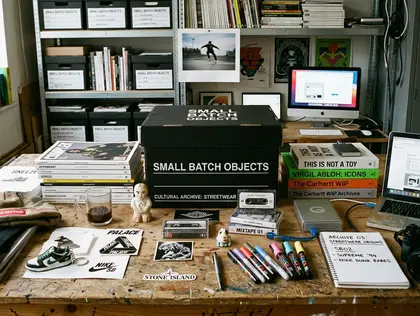
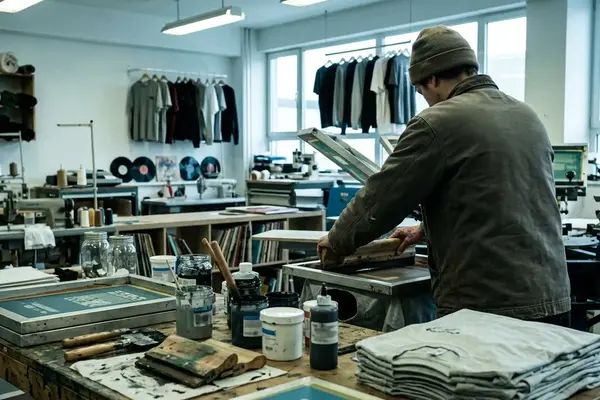
The most useful streetwear signals rarely arrive as polished campaigns. They show up as one-color screen prints, locally produced caps, risograph inserts, hand-numbered records, and pre-order windows that last days rather than full retail seasons.
Watch closely and these objects perform like cultural sensors. If a 100-piece cap run becomes a badge inside a scene, that matters more than a billboard. If a Wool flannel overshirt appears in a few release-party photos and then gets echoed by kids outside the venue a couple of weeks later, the signal has moved from styling into behavior.
Key Takeaway: Not every independent label becomes a streetwear engine; the labels that matter visually are the ones with repeatable art direction, physical-object discipline, and a community that treats releases as identity markers.
Major labels usually chase what already looks profitable. Independent labels work closer to the first spark.
LuckyMe and the Blueprint for Lifestyle Curation
Glasgow's LuckyMe, founded in 2007, landed at the exact collision point where blog-era discovery, limited apparel drops, and image-heavy social platforms began to feed each other.
That timing matters. A label no longer needed to wait for a magazine spread or a retail buyer to translate its taste. It could publish the sound, the image, the object, and the social proof in the same week. LuckyMe understood that early, and treated the label less like a release schedule than a design house with a bass bin.
A& R as Network Maintenance
Managing Director Martyn Flyn's approach to A& R is best understood through relationships, not audio output alone. The question was not simply, “Can this artist deliver singles?” It was sharper: can this collaborator extend the label's graphic, photographic, and sartorial language without breaking the world already being built?
That makes the work closer to post-modern bespoke tailoring than standard label management. A tailor reads posture, fabric, occasion, and attitude before cutting cloth. LuckyMe read producers, designers, photographers, illustrators, and audiences in the same connected way.
Its visual program has repeatedly paired records with prints, apparel, posters, and tightly art-directed digital releases. Merch did not sit at the end of the process as a monetization shrug. It sat inside the identity system.
Pro Tip: A label-as-lifestyle model only works when visual talent sits near the center of the operation. Without credible in-house or adjacent art direction, the lifestyle layer collapses into ordinary logo merchandise.
This is the point streetwear often misses when it raids music for references. The good labels are not moodboards. They are living workshops with taste under pressure.
Building Visual Universes: From Dead Cruiser to Trill
The safer article would list musicians who dress well. It would also miss the mechanism.
The strongest audio-sartorial movements happen when clothes, persona, sound, artwork, and public behavior repeat until they become one readable world. Audiences do not follow a jacket. They follow a code.
Kavinsky and the Night-Drive Silhouette
Kavinsky's Dead Cruiser persona turned retro-futurist electro into a menswear script. The night-driving, red-jacketed antihero gave people more than a synth palette. It gave them satin bombers, dark denim, driving gloves, black leather, angular sunglasses, and 1980s automotive color blocks.
That look worked because it never felt detached from the sound. The clothes carried the same chrome-lit loneliness as the music. Put the jacket in a random luxury campaign and it becomes styling. Put it next to the track, the car, the cover art, and the dead-eyed performance image, and it becomes a uniform.
A$AP Rocky and the Trill-to-Tailoring Bridge
In the early 2010s, A$AP Rocky helped make another bridge visible: underground rap styling moving into high-end bespoke tailoring without losing the street grammar. Designer coats sat with graphic tees. Bespoke suits sat with bandanas, gold jewelry, and skate-adjacent footwear. The outfit language was not polite fusion. It had teeth.
This is where heritage sportswear, luxury tailoring, and hip-hop self-mythology started speaking in the same frame. Mitchell & Ness throwback energy could sit beside runway outerwear because the persona made the mix legible.
The operational detail is repetition. The same wardrobe codes had to appear across videos, performances, press imagery, cover art, and candid street shots before audiences read them as a world rather than a costume.
- Videos establish the fantasy.
- Performances prove the fantasy can move.
- Press imagery freezes the code for wider circulation.
- Street shots make the audience believe the code survives daylight.
So the real question for any label is not, “Does the artist have style?” It is: can the style survive repetition without turning into cosplay?
When Heritage Brands Tap the Underground
Established brands rarely invent these codes. They translate them.
A heritage brand watches underground labels and artist-led scenes for signals that already have audience proof: club flyers, hardware, local release nights, hand-tagged packaging, shop programming, bootleg-adjacent graphics, and the kind of outfit repetition that cannot be faked by a casting director in one afternoon.
Cheap Monday x Teenage Engineering: Object as Signal
The mid-2010s collaboration between a Swedish fashion label and an electronic hardware studio worked because the object had a job. Pocket-sized synthesizer modules, including the PO-12 Rhythm, were not decorative props taped onto a campaign. They had real buttons, a real sequencer interface, and a toy-like industrial design that matched youth fashion's appetite for functional gadgets.
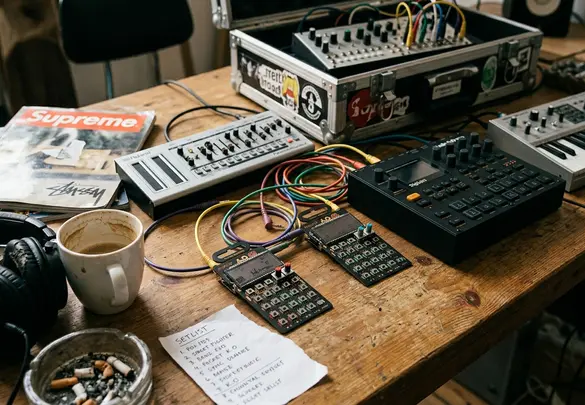
The synthesis felt believable because Swedish electronic minimalism, budget-studio creativity, and black-denim youth uniforming already shared a visual temperature. The pocket operator looked like something you could actually use on a train, in a bedroom studio, or in the corner of a release party.
Puma, Trinomic, R698, and the Room Around the Shoe
Puma's underground music tie-ins around Trinomic-era and R698-style footwear storytelling followed another useful route. Rather than leaning only on mass advertising, the brand paired sneaker releases with intimate performance formats, local cultural hosts, and shop-level programming. Events like the Alife Sessions mattered because the room around the shoe carried as much meaning as the shoe itself.
That is the part big brands often underprice. The host, the store, the DJ, the door policy, the photographer, the flyer, the after-hours chatter: all of it forms the semiotic scaffolding. Without that scaffolding, a sneaker is just product with borrowed noise around it.
Context-dependent variation matters here. Electronic labels often push streetwear through hardware, typography, and modular objects, while rap-adjacent labels tend to move faster through jewelry, outerwear, footwear, and public persona styling. FC St. Pauli, the German football club, offers a parallel lesson from terraces rather than studios: symbols travel when a community treats them as belonging, not decoration.
The Cost of Cultural Strip-Mining
Partnership is not extraction with better lighting.
The difference shows up fast, usually within one product cycle. A fashion capsule copies underground flyer typography and club lighting, books no scene artists, credits no designers, and sells the look at a premium. The audience reads it clearly: not homage, extraction.
Ground-level engagement looks operationally small but culturally expensive. It means paying for artwork, pressing limited physical editions, supporting short-run apparel, underwriting local release nights, and letting the label control credits and visual direction. None of that sounds glamorous in a boardroom. That is why it works.
Warning: Buying cultural cachet after a movement peaks is not strategy. It is late-stage shopping with a bigger invoice.
Fashion brands earn subcultural credibility by showing up before the moodboard is obvious. They fund the messy part. They learn the names. They accept that the label may care more about a hand-numbered 12-inch, a local photographer, or a basement release night than a polished campaign asset.
Long-term audio-sartorial partnerships need repeated collaboration across several drops or releases, not a single campaign built around a borrowed scene aesthetic. The future of streetwear will not come from another brand pretending it discovered the underground after the underground already did the work. It will come from patient alliances between labels, artists, designers, stores, and listeners who understand that sound and clothing are not separate languages. They are the same argument, cut in different materials.