The Cost of Historical Illiteracy
The notification pings. A highly sought-after piece of late-nineties outerwear has just surfaced on a popular resale platform.
The description is breathless, packed with keywords designed to trigger immediate purchase anxiety. According to the seller, it was sourced directly from a retired football casual in Manchester. Its price tag reflects a museum-grade artifact. Closer inspection of the pixelated images reveals a modern reproduction printed on a deadstock blank. Secondary markets run on this potent mix of nostalgia and urgency. Buyers who cannot distinguish between historical garments and modern knockoffs risk paying premium prices for stolen intellectual property.
Mislabeling lazy graphics as 'archive' actively erodes the cultural history and documentation of underground subcultures. Treating resale app descriptions as gospel carries a steep financial and cultural penalty. Test archive claims against three forms of evidence: a season or production date, a traceable design source, and physical construction consistent with that period. Treat descriptions such as "rare," "museum piece," and "from the archive" as unverified until the seller supplies clear images of the neck label, care label, print surface, seams, and full front and back.
For garments presented as late-1990s or early-2000s pieces, compare them with dated editorial scans, retail catalogs, lookbooks, flyers, or photographs from the claimed period rather than relying on recent resale listings.
The echo chamber of modern resale platforms frequently amplifies misinformation. One incorrect listing spawns dozens of identical errors, creating a false consensus built on zero foundational evidence.
The Dilution of the Archive Label
The term 'archive' has shifted from museum-grade preservation to a meaningless marketing buzzword. Moodboards and secondary markets incentivize sellers to attach the label to anything older than three seasons. A garment released roughly six to eighteen months earlier may already be called "archive" in secondary-market copy.
Age alone does not establish rarity, design importance, or preservation value.
This dilution actively harms the documentation of underground subcultures. When every oversized graphic tee receives the archive designation, the truly significant pieces lose their historical weight. Garments that defined specific movements in terrace culture or early streetwear become indistinguishable from mass-produced mall graphics. Flatten menswear history far enough and genuine runway samples sit alongside those mall graphics under the exact same search tag. This algorithmic compression destroys context, reducing decades of design evolution into a single, easily monetized keyword.
Institutional and working design archives describe objects meticulously. They record the maker, date, collection, material, condition, ownership history, and supporting documentation. A defensible catalog entry should narrow the date beyond a decade when evidence permits. Curators use a collection designation such as spring/summer 2004, an approximate production window, or a documented first appearance. Physical verification carries the rest of the weight, which is why institutional design archives insist on it.
A Taxonomy of Graphic Appropriation
Graphic appropriation requires a strict taxonomy to separate cultural artifacts from lazy cash grabs. Reference involves recontextualizing an existing idea to create a new dialogue. Designers borrow a silhouette or a color palette to communicate a specific homage, adding their own perspective to the conversation. Parody relies on subverting a recognizable logo or graphic for humor or critique, operating within specific legal boundaries of parody and fair use.
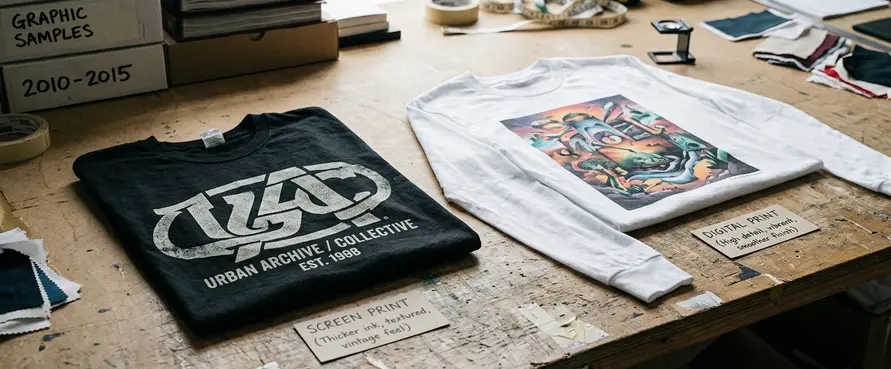
Bootlegs and theft occupy entirely different spaces. Differentiate between unauthorized reproductions that serve a specific cultural moment and lazy one-to-one copying for quick profit. Unofficial music, sports, and street-market shirts circulated across the 1990s can now carry archival relevance when their makers, distribution routes, audiences, and cultural moment are documented. The same judgment cannot be assigned automatically to a recent one-to-one graphic copy. Historical importance can emerge around an unauthorized object, but cultural afterlife does not retroactively make every bootleg original, ethical, or legally authorized.
Compare the suspected garment beside the earliest located source image. Check typography, crop, color order, halftone pattern, illustration contours, and placement. Matching small defects or unusual spacing can reveal direct reuse more clearly than a shared theme. This scrutiny applies equally to vintage Mitchell & Ness reproductions and underground terrace gear.
Verifying FC St. Pauli Provenance
When evaluating merchandise associated with clubs known for heavy subcultural crossover, demand period-correct documentation. A skull-and-crossbones graphic printed on a modern heavyweight blank holds zero archival value, regardless of the seller's narrative about 1990s terrace origins.
Developing Visual Literacy in Menswear
Developing visual literacy requires evaluating provenance from the garment outward rather than from the seller's story inward. The sequence begins with construction and labels, moves to the print method and wear pattern, and ends with graphic origin. Request sharply focused photographs of the label front and reverse, wash instructions, country-of-origin line, fiber content, underarm seams, hem, collar attachment, print edge, and interior behind the graphic.
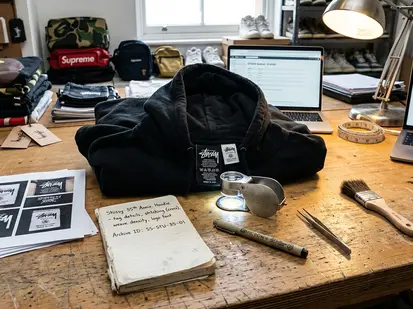
Single-stitch hems, double-needle hems, tubular bodies, and side seams function as contextual clues alongside other evidence. Production details vary by region, factory, price tier, and licensed market. Two authentic garments from the same collection may use different blanks, care labels, or print methods.
Analyze the ink and its interaction with the fabric. Discharge ink generally leaves a softer hand because pigment replaces dye within the fabric. Plastisol usually sits more distinctly on the surface and may split along repeated fold lines. Uniform digital distressing, identical crack shapes across separate listings, or a bright print on heavily faded cloth should trigger further comparison. A genuinely old blank can carry a newly applied print, so faded cotton, cracked ink, and a period-correct tag do not prove that the graphic and garment began together.
Wear patterns offer another layer of authentication. Authentic vintage garments develop distinct fading along high-friction areas like the collar, cuffs, and hem. The fabric thins naturally over decades of washing and wearing. Modern distressing techniques often fail to replicate this organic degradation, resulting in uniform fading or artificial holes that lack the frayed edges of genuine wear. A bright, pristine graphic sitting atop heavily faded cloth should immediately trigger further comparison. The aging process of the ink must match the aging process of the underlying fabric.
Cross-reference the graphic through material dated within the claimed release window. Consult brand lookbooks, print editorials, shop catalogs, concert photographs, scene flyers, or collector scans. Confirm that the graphic, blank, tag generation, and construction coexist in the same period. Inspecting a heavy wool flannel overshirt demands the same rigor as authenticating a graphic tee. Every component must align with the claimed era of production.
Demand Better Curation
Stop rewarding lazy design. Demand actual historical context before accepting the 'archive' label. An archive designation should answer what the object is, when it appeared, who produced it, how the attribution was made, and where the supporting evidence lives.
The burden of proof rests entirely on the seller.
Before paying an archive premium, require at least one garment-level evidence set and one independent period source. Multiple current resale listings repeating the same wording still count as a single unsupported claim. Curatorial copy should separate verified facts from inference with language such as "documented in autumn/winter 2003 material," "label suggests early 2000s production," or "maker remains unidentified" instead of compressing uncertainty into the word "archive."
Reject the inflation of the term. Hold curators to a higher standard of visual literacy. Force the market to document its history properly. Refuse to subsidize the erasure of menswear heritage. And the next time a listing promises a museum piece with nothing but a cropped phone photo behind it, ask for the neck label — then wait to see whether the seller ever sends it.