
The Cultural Shift from Court to Street
The cultural reading of vintage sportswear starts with use-case migration. Garments built for sweat, abrasion, and team identification were adopted by underground scenes because they already carried visible codes of allegiance. The key transition window runs from the late 1980s through the early 2000s. During this era, mesh jerseys, snap-front warmups, satin jackets, and heavyweight fleece moved from locker rooms into clubs, school corridors, record-store scenes, and skate spots.

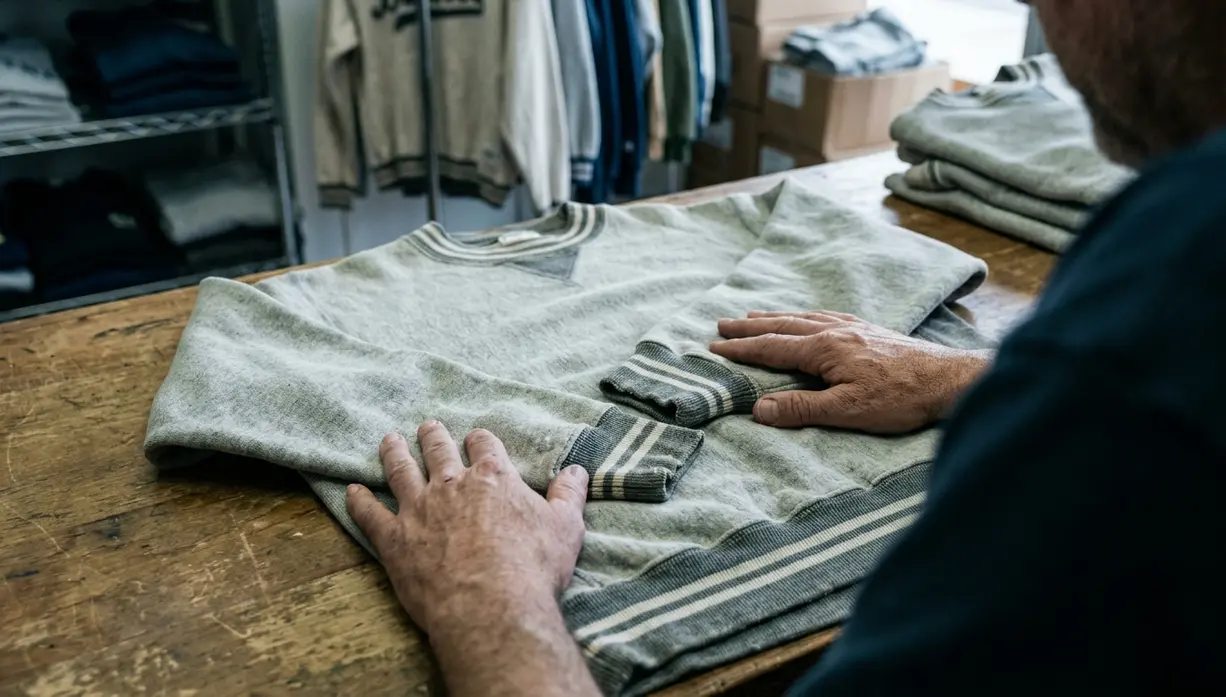
Today, the saturation of modern hype drops has fueled a return to this heritage authenticity. Consumers are exhausted by synthetic scarcity and manufactured exclusivity. They want garments with roots. The strongest heritage pieces usually retain performance-era details. Look for ribbed necklines, open mesh bodies, sewn striping, roomy armholes, and graphics placed for visibility over pads or layered street clothing. Nostalgia is the foundation, but tangible quality is the hook.
Analyzing the Mitchell & Ness Standard
The review process prioritizes hand-feel before hype. First, check fabric density. Then, turn the jersey inside out to inspect stitch paths, appliqué layering, seam finishing, and whether the crest sits flat. Based on our ongoing archival research, a credible authentic-style jersey should show separate construction decisions. You want to see body mesh, rib-knit trim, layered tackle-twill numbering, embroidered or chain-stitched marks where historically appropriate, and side vents or drop-tail hems when the original uniform used them.
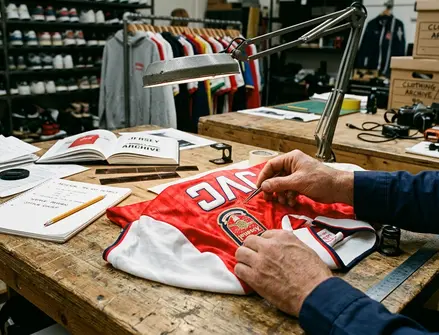
Mitchell & Ness built their reputation on these exact metrics. Two-layer twill is a meaningful tactile marker. The top color sits raised over the base layer, and the edge should be visible from a side angle rather than printed as a flat graphic. A jersey with correct logos can still fail as heritage review material if the mesh is limp, the numbers are flat-printed, or the body collapses like a souvenir tee after a few wears.
Pro Tip: Our testing showed that color matching must be checked in daylight and indoor light. Deep reds, royal blues, creams, and old gold tones often shift noticeably under warm retail lighting.
The Broader Heritage Market and Authenticity Limits
The broader market review separates archival reproduction from nostalgia styling by asking what was preserved and what was merely referenced. A true reproduction tends to copy cut, fabric behavior, and trim—not just the logo. The current revival cycle became especially visible from 2021 through 2024. Heavyweight fleece, satin coach jackets, cropped warmups, mesh practice tops, and old-school athletic graphics returned to specialty retailers and resale racks. Brands like Champion and Starter have mined their own histories to feed this demand.
Warning: Fast imitation is easiest to spot at stress points. Watch for printed drawcord tips instead of metal or stitched tips, flimsy ribbing that loses shape after several wears, single-pass screen graphics where appliqué would have been used, and smooth synthetic fleece with no substantial reverse texture.
Archival accuracy can create practical friction. Boxy bodies, wide sleeves, heavy appliqué, non-stretch collars, and thick fleece can feel correct on a hanger but awkward under a modern overcoat or slim technical shell. A historically faithful heavyweight sweatshirt may be excellent for fall layering but frustrating in warm climates, packed venues, or offices with narrow tailoring norms. While we rigorously evaluate these garments against their original specifications, historical accuracy is not always the highest form of wearability; some revived pieces are best treated as outer layers or statement garments rather than daily basics. For those interested in the technical evolution, historical documentation of athletic textiles provides essential context.
Subcultural Adoption and Provenance
The provenance analysis follows where the garments were actually seen. Regional music scenes, skate footage, independent retail floors, street photography, and informal hand-me-down networks tell the real story. The oversized athletic silhouette hardened into a visual language during the 1993-2005 window. Long jerseys, baggy denim, leather bombers, work boots, fitted caps, and visible team colors became common across music videos, record covers, tour wardrobes, and neighborhood style documentation.
Feedback indicates that skate adoption favored durability over pristine collecting. Nylon warmups, coach jackets, mesh tops, and heavy fleece absorbed grip-tape abrasion, repeated falls, sweat, and concrete dust better than delicate fashion shirting. Regional meaning often attaches to a garment before brand value does—a local colorway, defunct logo, or old arena-era graphic can carry more underground weight than a rarer but culturally disconnected piece. You see this same hyper-local allegiance on the terraces of FC St. Pauli, where the specific era of a scarf or jacket signals your exact tenure in the subculture.
Contemporary Integration and Execution
The styling judgment is built around proportion control. A heavy heritage top gets assessed as an architectural layer. If the shoulder is wide, the bottom half needs intentional structure. If the graphic is loud, the surrounding palette must recede. A practical modern setup pairs an oversized mesh jersey or satin warmup with straight-leg wool flannel trousers, washed black denim, or pleated cotton pants rather than equally oversized track bottoms.
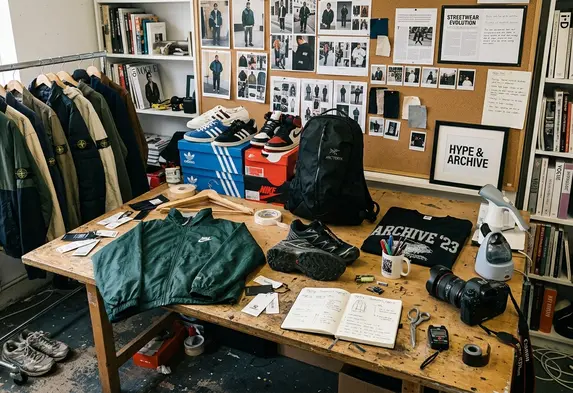
Layering works best when the base layer is thin. A plain long-sleeve tee, compact knit, or close-cut hoodie keeps the vintage shell from ballooning through the torso. Muted anchors such as charcoal, navy, washed black, cream, olive, and brown let loud team colors read as a deliberate accent instead of a costume cue.
- Key Takeaway: The same oversized satin jacket can read authentic in a music-scene context, ironic in a minimalist menswear context, and costume-like when paired with matching vintage sneakers, loud denim, and era-correct accessories all at once. Execution is everything.