
Sneaker culture did not grow tired because people stopped caring about shoes. It grew tired because the buying ritual began to outrank the object. That is the hinge of this story — not taste, not age, not some clean generational handover, but a slow shift in where meaning got attached.
When launch mechanics teach a buyer to chase permission before judging proportion, material, or wear, the shoe becomes secondary. Menswear noticed. The summer pavement noticed. Independent brands noticed first.
In this Article
- The Hype Machine and Market Saturation
- The Minimalist Rebellion in Menswear
- Archival Reverence vs. Collab Fatigue
- The Indie Blueprint: 10 Years of Clae
- The Future is Ethical and Directional
The Hype Machine and Market Saturation
Access became the design brief
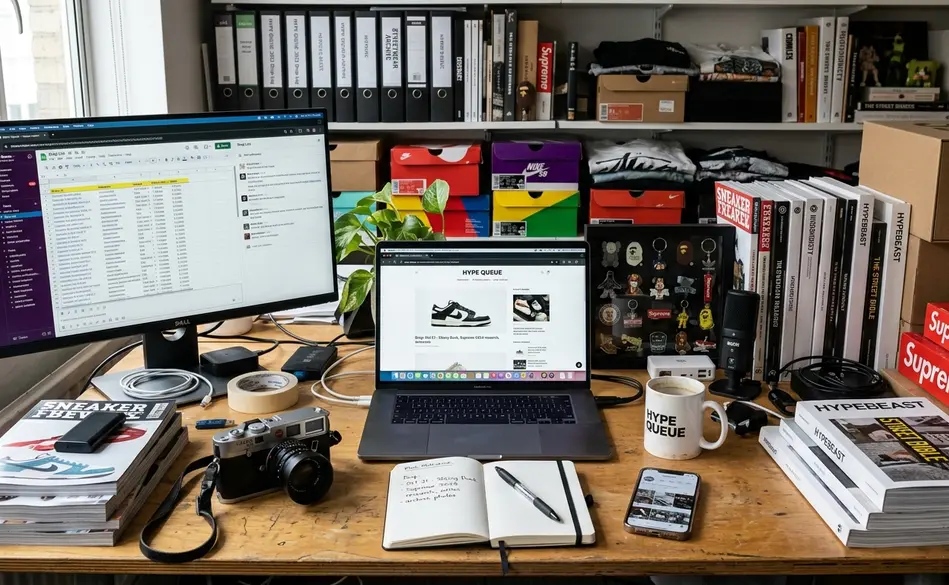
I keep returning to the launch funnel, because it explains the exhaustion better than any moodboard. Nike Snkrs and Adidas Reserve did not just distribute shoes; they trained a different reflex. Open the app. Enter the queue. Wait for permission. Feel the little sting of denial or the short-lived voltage of access.
That psychology did more damage to taste than bad colorways alone ever could.
Technical footwear language visibly crested around 2014. Sock-fit construction, neoprene tongues, heel cages, and exoskeletal overlays moved from performance design into everyday streetwear styling. Tinker Hatfield's Nike Air Huarache had already given the market a legitimate grammar for anatomical cut-outs and visible support structures, but by this point the language was being copied faster than it was being understood.
The 2015 problem was legibility
By the 2015 buying cycle, saturation was no longer subtle. It sat in over-segmented uppers, color-blocked panels, and app-first release calendars that made mediocre shoes feel artificially urgent. A runner could have four materials, three overlay systems, and no coherent reason for any of them.
Warning: Complexity is not the same as construction intelligence. A heel cage earns its keep only if it stabilizes the foot, resolves the line, or does both. Otherwise it is decoration wearing a lab coat.
The duopoly problem was not that Nike and Adidas lacked design talent. The problem was that the market had learned to reward urgency before wearability. Once a launch calendar starts making subpar footwear feel like a moral test, the culture is already running hot.
The Minimalist Rebellion in Menswear
White leather did not arrive quietly
Cropped trousers. Washed denim. Tonal shirting. No-show socks. Summer outfits began making large, technical runners look like leftover machinery.
Then came the white on white reset.
The cleaner summer uniform favored white leather or canvas low-tops, low-profile soles, minimal branding, and tonal laces. It was not nostalgia for plain shoes. It was styling behavior becoming more precise. When the hem rose and the trouser widened slightly, the foot needed less spectacle and better proportion.
Archetypes beat noise
The important models were not obscure. Adidas Originals Stan Smith, Puma Basket, and Converse Jack Purcell all had a simple advantage: their shapes knew when to stop. Archival tennis lows, suede court shoes, and rubber-toe plimsolls gave menswear a cleaner baseline than multi-part runners could offer.
- Low-profile soles let cropped hems sit cleanly without a visual argument at the ankle.
- Minimal branding allowed texture, fit, and fabric to carry more of the outfit.
- Tonal laces reduced visual breaks, especially on white leather and canvas.
- Simple lasts worked with washed denim, Wool flannel overshirts, and stripped-back summer tailoring.
Pro Tip: A minimal sneaker can still be cynical if it simply removes panels while keeping artificial scarcity, app-only access, and disposable build quality.
That is the part the market still dodges. Is the shoe quiet because the designer edited it, or because the marketing team found a cheaper way to look restrained?
Archival Reverence vs. Collab Fatigue
Memory is not inventory
Archive-heavy footwear reads differently in places where the referenced music scenes, court shoes, skate codes, or terrace uniforms were lived locally rather than imported as moodboard images. A club reference in Manchester, a court shoe in New York, a terrace-coded trainer around FC St. Pauli, the German football club: these things carry local weather, politics, and repetition. They are not just colors on a sample sheet.
That distinction separates heritage work from logo churn.
Reebok Classics understood the stronger route with ‘Give Me Your Classics And I’ll Show You The Future’, directed by Anthony Crook with Rig Out. The film used 1990s rave culture as its frame, leaning on track jackets, dancefloor movement, and documentary-style styling instead of a standard product campaign. The shoe entered through atmosphere. It did not need to shout from the centre of the frame.
When collaboration turns into clutter
The opposite problem surfaced around the 20th-anniversary cycle of the inflatable-pump running silhouette. Multiple partner makeups landed inside the same commemorative window, and what might have been reverence started to feel like calendar clutter. The archive became logo inventory.
The blunt Atmos backlash, often condensed into the F*** You Atmos sentiment, was less a single-store insult than a consumer shorthand. People were not rejecting collaboration as a category. They were rejecting endless churn dressed as cultural service.
A Mitchell & Ness throwback works when the garment understands league memory, city attachment, and fabric weight. Put the same logic onto footwear: the story has to touch something lived. If the reference cannot survive outside a caption, it was probably never heritage in the first place.
The Indie Blueprint: 10 Years of Clae
From flat graphics to three-dimensional restraint
Sung Choi's path matters because it was not a straight performance-footwear apprenticeship. He moved from 2D graphic design with PNB Nation into industrial footwear, and that shift changes the problem. A flat composition can create impact through surface, contrast, and logo rhythm. A shoe has to hold volume, flex, age, and sit under a body in motion.
That move from graphic streetwear into product restraint explains much of Clae's early clarity. Choi founded the independent footwear label in 2001, positioning it against the athletic-footwear duopoly by focusing on everyday lifestyle shoes rather than court, track, or running performance. It was not anti-sneaker. It was anti-overstatement.
The March 2011 marker
Clae's 10-year anniversary in March 2011 now reads as a useful marker. It lands before the later wave of luxury-minimal sneaker dominance, which means its influence belongs to the groundwork rather than the afterparty. The label helped prove that contemporary menswear could treat sneakers as daily objects without dragging every pair back to sport.
Choi's reference pool also explains the tone: 1950s-1960s jazz, university radio habits, and mid-century jazz press archives. That does not produce loud footwear. It produces muted palettes, restrained shapes, and quiet material choices. You can see the design logic in the absence of panic.
The independent blueprint is not simply ‘make fewer shoes’. It is a construction argument: build a last that works with trousers, choose materials that improve with wear, and leave enough silence for the wearer to enter the object.
The Future is Ethical and Directional
Longevity is the next credibility test
The next credible sneaker will not be saved by another scarcity mechanism. Product has to outlast marketing. That means better uppers, cleaner lasts, longer cycles, and sourcing claims that still make sense after launch week has gone cold.
In the late 2000s and early 2010s, responsible footwear experiments were already visible through recycled rubber, water-based adhesives, non-animal material programs, lower-impact leathers, and more transparent factory claims. Brands like Ahnu, Dr. Marten’s, and Macbeth showed that responsible production did not have to arrive in beige packaging with all subcultural edge filed off.
The sharper conversation now sits around ethical manufacture and sustainability, not as a soft virtue signal but as a construction standard. Ethical positioning only carries weight when a brand can document material inputs, labor conditions, and manufacturing partners beyond campaign copy.
Directional does not mean disposable
There is still room for strange shoes. There should be. Sneaker culture without risk becomes catalogue dressing, and nobody needs another dead-eyed wall of tasteful white lows.
But directional design has to answer harder questions now. Does the upper make sense after fifty wears? Does the outsole belong to the last, or did it come from a trend file? Can the brand explain the adhesive, the leather, the rubber, the factory relationship, and the product cycle without hiding behind a drop mechanic?
Key Takeaway: The future belongs less to artificial scarcity and more to shoes with cultural memory, material accountability, and enough construction intelligence to remain useful after the hype has moved on.
Minimalism exposed the exhaustion. Indie brands offered the working model. Ethical production is the next test. The sneaker that lasts will not need to beg for urgency.