
Testing Menswear Claims Against the Garment
A hoodie’s product page promises recycled fabric. Its sewn-in label lists a blend. The collection page carries a leaf-shaped badge, while the take-back link leads to shipping instructions. Each supplies a different piece of evidence. Together, do they substantiate the promise?
Supply chain auditing means systematically checking a garment’s composition, disclosed manufacturing tiers, and end-of-life arrangements against its marketing claims. I start with the claim, then identify what would support it: a component label, a certificate linked to the product, a named dyehouse, or an operating collection service.
Archive culture already supplies the habit of close inspection. Collectors read style codes, scrutinize construction, and distinguish one season’s release from another. Applied to sustainability, that attention moves beyond scarcity toward physical specifications and production transparency. A wool flannel overshirt deserves the same scrutiny as a collectible sneaker.
Our editorial garment-spec archive dates to 2016. It provides context for reading product claims; mill-level documentation provides production evidence. The two serve different purposes.
Pin Down the Hoodie
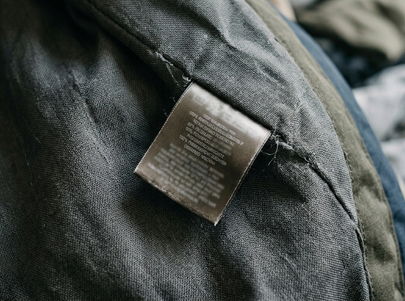
Record the product name, style code, colorway, and inspection date. Another season’s certificate cannot substantiate this season’s garment. Keep three evidence layers separate: the sewn-in composition label, documents connecting claims to production, and proof that advertised services operate.
A buyer can assess public substantiation; undisclosed purchasing documents remain beyond reach. Mark missing evidence unverified, without treating the gap as proof of misconduct.
Read the Blend Before the Sustainability Badge
A recycled-insulation claim can be accurate while telling you nothing about a jacket’s shell or lining. Likewise, a hoodie containing some organic cotton may contain other fibers. Read each component’s percentages before letting a material claim describe the whole garment.
Third-party certification needs equally precise reading. The Global Organic Textile Standard, or GOTS, distinguishes its “organic” grade, requiring at least 95% certified organic fibers, from “made with organic materials,” requiring at least 70%. Its requirements also cover processing, including restrictions on chemical inputs.
Check the certification body, certified entity’s license number, and scope in the relevant certification records. Organic content, recycled-content traceability, and chemical processing describe different subjects. An internal brand badge supplies no equivalent verification on its own.
Follow the Fiber Mix
Stretch and durability complicate the next stage. Mechanical recycling tears textiles back into fibers, generally shortening them. Elastane complicates processing; cotton-polyester blends need separation or a route designed for mixed feedstock. Sorting equipment identifies material, but identification alone cannot separate fibers already combined within a yarn.
Mixed-fiber recycling is difficult and route-dependent. A collection bin supplies an intake point; a textile-to-textile claim needs a named process and destination. When the label combines cotton, polyester, and elastane, where will those fibers actually go?
Trace the Dyehouse, Then Question the Drop Calendar
A factory list becomes useful when you know which work each factory performs. Follow the garment upstream through four tiers:
- Tier 1: cut-and-sew assembly.
- Tier 2: fabric manufacture and wet processing, including dyeing and finishing.
- Tier 3: yarn spinning.
- Tier 4: fiber cultivation, extraction, or other raw-material production.

Assembly disclosure leaves substantial questions unanswered. Tier 2 processing can involve water, heat, salts, dyes, and treatment chemicals. Look for water-withdrawal information, wastewater treatment, and chemical management. Fabric formation and dyeing may happen at separate facilities; a supplier’s headquarters address identifies neither process.
Useful facility records give the legal name, location, activity, and disclosure date.
Then widen the frame to the release calendar. One lower-impact capsule establishes evidence about that release. Understanding the wider business requires annual units produced and sold, with garments separated from accessories and reporting periods aligned. Revenue cannot answer that production question.
Weekly drops warrant scrutiny, but frequency alone proves neither air freight nor synthetic-blank sourcing. Those require shipment-mode disclosures and composition records. Keep the questions separate: how much gets made, what it contains, and how it travels.
The capsule’s credibility reaches only as far as its documented scope.
Score Five Evidence Trails Before Buying
I use five equally weighted checks to keep an attractive campaign from dominating the decision. Award one point for each substantiated item, producing a score from zero to five. Leave unsupported claims unverified.
- Exact fiber percentages. Capture the internal label’s composition, including separately stated shell, lining, and insulation materials.
- Named Tier 1 and Tier 2 facilities. Seek assembly, fabric-production, and wet-processing identities, with locations, activities, and disclosure dates.
- Verifiable certification identifiers. Match the license or certificate identifier to its holder, standard, and relevant scope. A number elsewhere on the website does not cover every product automatically.
- Annual production volume. Require a reporting year, units, and scope. Distinguish production from sales and garments from accessories.
- An active aftercare route. Verify repair, hardware replacement, or take-back arrangements: eligible products, intake instructions, charges, shipping, and the destination of collected garments.
Photograph Before Checkout
In-store, photograph the composition label and style code. Online, save the product claim and inspection date, then follow the certificate and supplier records. If take-back earns a point, check where the garment goes after collection. The score measures disclosed evidence—not the garment’s total environmental impact.
Regulation is moving product information toward machine-readable scrutiny. The EU’s Ecodesign for Sustainable Products Regulation establishes a framework for product-specific requirements, including Digital Product Passports linked to a data carrier. The applicable rules will determine required fields and implementation dates; exact supplier tiers, material origins, and repairability fields cannot yet be promised for every garment.
The 2025–2030 working plan prioritizes textiles and apparel, with rule adoption indicatively scheduled for 2027. That milestone concerns adopting requirements, rather than an apparel compliance deadline.
The green hangtag now faces a different kind of scrutiny: product evidence readable through a data carrier. The legal framework behind that shift entered into force on 18 July 2024.