In this Article
- The Cultural Translation Problem
- Reading the Goutte d’Or Through Cloth and Construction
- Why Rue Myrha Had to Come First
- Putting the Neighborhood Inside an Air Jordan
- Saturday Pavement in the 18th
The Cultural Translation Problem
How does a label translate the hyper-local visual culture of a Parisian immigrant district into a global streetwear language without gentrifying its own origins?
That question sits beneath Maison Château Rouge. Youssouf Fofana established the label in 2015, drawing its identity from the Goutte d’Or in Paris’s 18th arrondissement. The district lies around the Château Rouge and Barbès-Rochechouart Métro stations, removed from the luxury-shopping axis associated with the 1st and 8th arrondissements. Fashion authority traditionally flowed from those central addresses. The Goutte d’Or developed its own authority through markets, specialist shops, football culture and daily improvisation.
Rue Dejean is central to that system. Food stalls, textile commerce and made-to-measure boubou shops place African-diaspora culture inside the district’s ordinary retail infrastructure. It appears in fabric bolts being carried between shops, in a trouser hem adjusted by a local tailor and in the way a football top meets a work jacket on the pavement. These are working codes rather than seasonal references waiting for a designer to discover them.
The initial task was therefore precise: build a contemporary menswear label capable of holding both Parisian and African identities without reducing either one to a postcard. Souvenir-shop clichés would have been easy. A map coordinate on a sweatshirt, a few bright prints and a neighborhood name could signal affiliation from a distance. Such devices rarely survive close inspection.
Maison Château Rouge treated the neighborhood as a design system. West and Central African cloth retail supplied pattern and color. Local tailoring supplied construction cues. European workwear and globally familiar sports garments offered silhouettes that could travel. Improvised styling around Rue Dejean supplied the friction between those elements.
Goutte d’Or culture enters the clothes through construction, proportion and context—not through a borrowed graphic alone.
This distinction matters because cultural translation always changes its source. The useful question is whether the change retains meaningful relationships: between cloth and cut, shop and street, label and local audience. Maison Château Rouge built those relationships before asking an international customer to understand them.
Reading the Goutte d’Or Through Cloth and Construction
Start with the seams. Contrast topstitching, bound openings, patterned panels and abrupt fabric changes carry more of the neighborhood vocabulary than a chest logo ever could. They ask the wearer to look at how a garment has been assembled.
Wax print supplies an obvious visual charge, though its history requires care. It is a transnational textile shaped by European industrial production, West and Central African trade networks and locally assigned pattern meanings. Treating it as an untouched ancient fabric flattens that history. Treating it as a living commercial language makes room for movement, adaptation and contemporary use.
The Goutte d’Or’s tailoring shops add another layer. Piping can mark an edge that a mass-market garment would hide. Pattern can cross a placket or interrupt a pocket. Appliqué-like layering turns finishing into a visible event. These decisions echo made-to-measure clothing without copying a traditional garment wholesale.
Then comes silhouette. Baseball jerseys, overshirts and chore coats provide forms that streetwear customers can read immediately. A baseball jersey already carries associations with team identity, collecting and American sportswear, familiar territory to anyone who has handled a Mitchell & Ness throwback. Maison Château Rouge can alter that structure through panel placement, patterned sections and conspicuous stitching while keeping the garment legible at first glance.
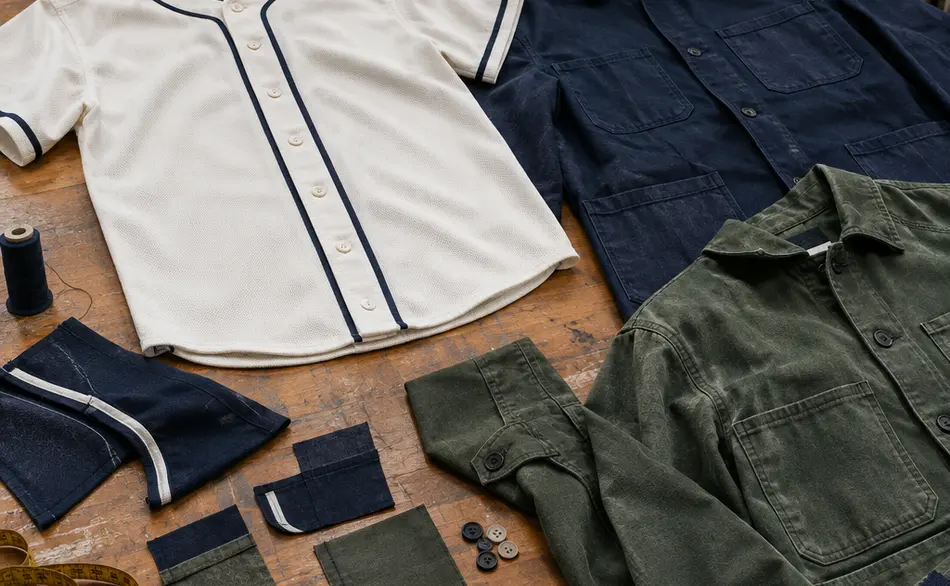
The strongest pieces operate on two viewing distances. Across the street, the color balance and sportswear shape register first. Up close, blue topstitching, matched patterns and layered edges reveal the harder work. This is structural translation: one visual language supplies the architecture, while another changes how the architecture behaves.
Run the Seam Test
- Check whether patterned cloth continues across pockets, plackets or paired panels.
- Look for fabric changes that alter the garment’s construction rather than merely decorating its surface.
- Inspect bound edges, contrast stitching and layered openings for evidence of deliberate finishing.
- Ask whether the piece would still carry its identity if the main logo disappeared.
This method places a ceiling on scale. Patterned cloth may need careful matching across garment sections. Textile availability can change, and inconsistent repeats make exact reorders difficult. Substitute fabrics and standardized repeats may improve volume while erasing the sourcing relationships that made the reference coherent. That constraint is specific to the materials and construction at hand.
Small-batch cutting becomes a strategic choice under those conditions. Limited runs protect detail and give the workshop room to respond to the cloth in front of it. Rapid expansion would demand uniformity; the Goutte d’Or vocabulary gains much of its force from controlled irregularity.
The benchmark is visible in the finished garment. Does the neighborhood survive at the seam, or has it been compressed into branding?
Why Rue Myrha Had to Come First
The Maison Château Rouge boutique sits at 40 Rue Myrha, within walking distance of Château Rouge Métro and the commercial streets around Rue Dejean. Choosing that address placed the product, its customers and much of its source material within the same few streets.
A conventional fashion strategy could have pointed toward Le Marais. Its existing flow of destination shoppers would make immediate commercial sense. Rue Myrha offered a tougher and more valuable test: could the clothing feel plausible beside local tailors, food merchants and residents before international buyers gave it status?
Neighborhood first, fashion system second.
The boutique turns that sequence into physical practice. A garment can leave the rail and enter the same streets that informed its pattern scale, color and proportion. Local customers do not need a campaign explanation to evaluate the reference. They can judge whether the result feels observant, forced or detached from the area’s daily reality.
That proximity gives the shop functions beyond selling stock. It acts as a meeting point, a test environment and a fixed address for the label’s cultural claim. International coverage may introduce a customer to Maison Château Rouge, but Rue Myrha shows where the claim is answerable.
Three Publics at One Door
The storefront serves overlapping groups whose needs rarely align perfectly:
- Nearby residents use Rue Myrha as part of an ordinary working and residential neighborhood.
- Paris-based fashion customers arrive with product knowledge and release expectations.
- International visitors often discover the address through streetwear coverage and collaborations.
Managing those groups has a practical edge. Deliveries, queues and release-day traffic unfold beside shopping trolleys, scooters and routine errands. The shop cannot behave as though the pavement were a private event space. Its credibility depends on remaining porous to the street rather than staging the district as scenery.
Protect the Pavement
Global relevance counts only while sneaker queues can still share Rue Myrha with Saturday grocery traffic. Queue management, deliveries and customer behavior become part of the brand’s cultural conduct.
This creates a sharper measure of authenticity than campaign language. A neighborhood boutique must negotiate with actual neighbors every week. The address keeps the story exposed to correction.
Putting the Neighborhood Inside an Air Jordan
Four years separated Maison Château Rouge’s founding in 2015 from the release of its Air Jordan 1 Mid SE Fearless on November 30, 2019. That sequence matters. The neighborhood-based identity existed before the global product, giving the collaboration a developed visual vocabulary to carry rather than a story manufactured for launch day.
The Air Jordan 1 supplied instant recognition. Its panels, overlays and basketball lineage formed a stable carrier for a more local set of decisions. Maison Château Rouge worked through cream leather, orange and yellow sections, blue contrast stitching, embossed patterning and layered edge treatments. Each intervention sat inside a silhouette already understood across sneaker culture.
The shoe’s original US retail price was listed at roughly $130. Later aftermarket listings moved with size, condition and date, making any single resale figure a weak benchmark. Continued resale visibility offers a more defensible signal: collectors kept searching for, listing and discussing the release after its initial retail moment.
That attention alone does not explain the collaboration’s value. The better test is whether the Goutte d’Or narrative remained visible once Jordan Brand’s scale entered the frame. Here, the material and color decisions did the work. Blue stitching recalled the label’s conspicuous finishing. Embossed surfaces and layered edges brought garment logic onto footwear. Cream, orange and yellow created a palette with enough character to survive the famous silhouette.
A Carrier With Global Reach
Selective partnerships work when each side has a defined role. Jordan Brand supplied distribution, recognition and a form understood from Paris to far beyond it. Maison Château Rouge supplied the cultural specificity. The collaboration succeeded because the larger platform amplified an existing identity instead of replacing it.
- Recognition: the Air Jordan 1 shape reduced the time needed to explain the product category.
- Specificity: stitching, embossing and edge treatments carried Maison Château Rouge’s established design habits.
- Sequence: four years of neighborhood-based development preceded the international release.
- Retention: the Parisian-African diaspora narrative remained attached to the shoe through its materials and presentation.
Global relevance can dilute a local label when every partnership demands a fresh costume. Maison Château Rouge took the opposite route. It placed familiar Goutte d’Or codes inside a corporate icon and allowed the sneaker to function as a broadcast device.
The result reached beyond collaboration hype. A customer encountering the shoe could follow its blue topstitching and layered panels back to a clothing label, then from that label to Rue Myrha, Rue Dejean and the broader retail culture of the 18th arrondissement. The product opened a route toward the source.
Saturday Pavement in the 18th
Just before midday on Saturday, the short route from Château Rouge Métro toward Rue Dejean begins to tighten. Shoppers steer market trolleys around produce crates. Fabric customers pass storefronts stacked with wax-cloth bolts. Scooters nose through gaps that pedestrians assumed were closed.
At 40 Rue Myrha, a release queue holds close to the façade. Some customers have arrived because they know every color and panel on the product. Others carry phones with the shop address open, having first met Maison Château Rouge through international streetwear coverage. Sneaker boxes begin to appear under arms.
The queue shares the street with residents moving between halal butchers, textile sellers and the produce commerce around Rue Dejean. Nobody pauses to provide a clean campaign frame. A grocery trolley clips the edge of the line. Two friends step aside, then reclaim their place. A delivery rider waits for enough pavement to open.
Inside, contemporary menswear sits on rails a few minutes’ walk from the cloth merchants and tailoring businesses that shaped its design language. Outside, the audience is mixed in age, purpose and familiarity with the brand. The scene resists the sealed atmosphere of a luxury corridor.
A customer leaves the boutique with a sneaker box tucked against his jacket. At the corner, he stops to let a woman pull a loaded market trolley over the kerb. She continues toward Rue Dejean; he turns toward Château Rouge Métro. For a few seconds, box, trolley, stitched product and working street occupy the same narrow strip of pavement.