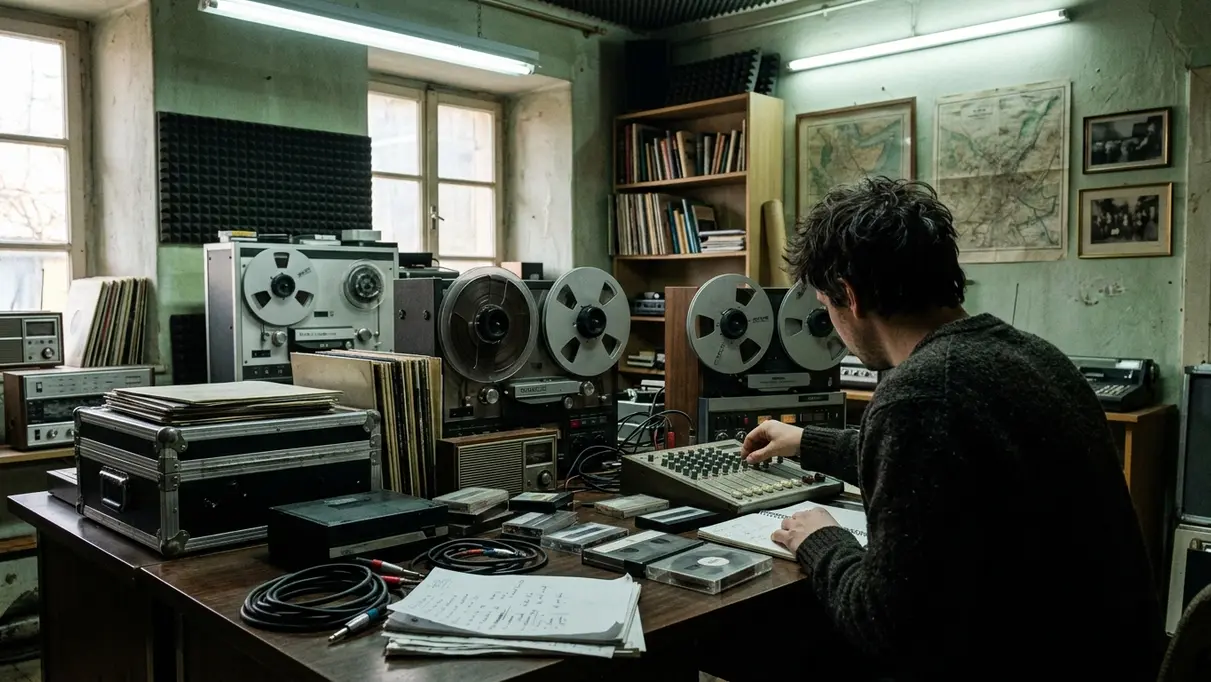

The Red Light in the Damp Room
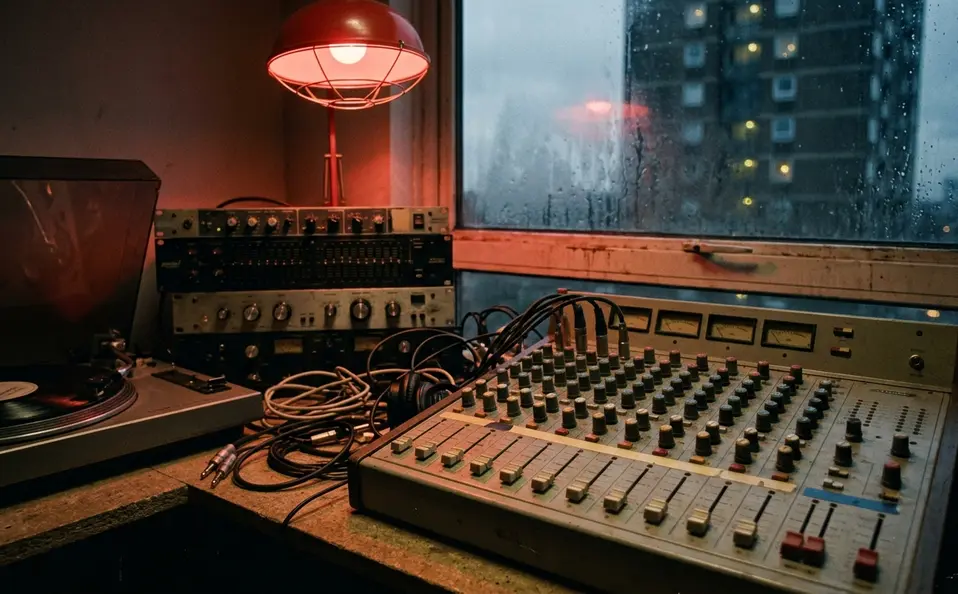
Condensation clouds the tower-block window. XLR leads knot beneath the desk, their connectors disappearing behind a mixer already crowded with faders and half-legible tape labels. Above it all, the red ON AIR lamp throws its reflection across the damp glass.
That cramped London room explains the purpose of a pirate radio mix better than a sweep through genre history ever could. An algorithm can place compatible tracks beside one another, yet compatibility alone carries little meaning. It flattens provenance, neighborhood memory and the tension between records into an efficient queue. The selector has to put those relationships back.
I begin by fixing the running order at exactly 60 minutes before detailed editing. Every introduction, blend, voice drop and abrupt cut must then compete for finite space. The boundary forces decisions; a loose collection of favorites gradually becomes an authored broadcast.
Capture 20 to 30 seconds of room tone as well. A restrained fragment under the opening ident locates the transmission in a real studio, with air and electrical texture, rather than in the frictionless nowhere of a playlist.
Lock the Hour
Treat the duration as part of the composition. Once the hour is fixed, each extra bar has a cost and every interruption needs a reason.
Club Sets Versus Broadcast Narratives
A dancefloor supplies its own connective tissue: moving bodies, room pressure and a crowd responding to each adjustment. The DJ can maintain physical momentum for an extended run because the sound system turns repetition into sensation.
Broadcast listening changes the contract. One person may be sitting in headphones, driving or watching sodium light pass across the windows of a night bus. There is no visible crowd response to carry a flat passage. The hour needs an opening invitation, a controlled rise, a deliberate release, a second ascent and a closing image.
Mark substantial structural changes at roughly 8- to 12-minute intervals. These chapters should register without making the mix feel as though it restarts each time. After three or four dense tracks, open some air through reduced percussion, wider ambience, spoken material or a meaningful tempo change. Relentless high-BPM pressure quickly turns dramatic records into background abrasion when bodies and a large sound system are absent.
Write With Contrast
Think in terms of pressure and release rather than a permanently rising line. A quieter passage can sharpen the next impact because the listener has recovered enough attention to hear it.
This construction method applies to prerecorded, studio-assembled broadcasts. Live vinyl remains contingent on cueing tolerance, the records within reach and decisions made in real time.
Track Selection and Tempo Mapping
Pull 20 to 25 candidates into the digital audio workstation or preparation software. The pool includes alternates, short fragments and full-length selections; only material that advances the hour survives. Tempo and key analysis offer a first pass, but audition records in phrases. Detuned bass or ambiguous harmony can mislead software while sounding obvious by ear.
Build the 10/40/10 Skeleton
- Minutes 0–10: establish the atmospheric hook. Introduce the station’s texture, rhythmic vocabulary and point of view without spending the hardest material immediately.
- Minutes 10–50: conduct the core excavation. Develop the main rhythmic argument, create the central release and rebuild toward the hour’s strongest press.
- Minutes 50–60: shape a memorable cooldown. Leave a final station-shaped afterimage instead of allowing the last peak simply to run out.
Place arrangement markers at 0:00, 10:00, 30:00, 50:00 and 60:00 before cutting transitions. A workable tempo map might open near 130 BPM, descend toward 90 BPM for the midpoint breather and climb to approximately 140 BPM for the climax. These values describe blocks, not handcuffs. Their purpose is to reveal where the mix changes gait.

Align conventional changes to 8-, 16- or 32-bar phrases. For long blends, favor matching keys, relative major-minor relationships or adjacent positions on a harmonic key wheel. Then mute the analysis display and inspect the bass notes by ear. Two tracks can appear harmonically compatible while their low fundamentals grind against each other.
Protect the Sub
At the seam between 130, 90 or 140 BPM, let one track own the sub range. The ident, delay tail or wheel-up can reset the ear while that ownership changes.
Transitions and the Art of the Voice Drop
Station idents, MC shoutouts and sampled dialogue function as structural joints. First find the joins where tempo, key or rhythmic density makes a conventional blend unconvincing. Place the voice across that seam, thin the outgoing low end and clear enough space for the incoming rhythm to arrive with authority.
Keep most voice drops within two to six seconds. That is enough time to identify the broadcast or change the emotional frame without smothering the first phrase of the next record.
Four Ways to Clear the Seam
- Bass handoff: reduce the outgoing material below roughly 100 to 150 Hz while opening the incoming bass over an 8- or 16-bar phrase. Avoid running both kick-and-bass systems at full level.
- Tape-delay tail: automate feedback upward only at the end of a word or phrase. Cut or filter the return before it obscures the next downbeat.
- White-noise rise: extend the sweep across four to eight bars when the transition needs gradual anticipation rather than shock.
- Sudden cut or wheel-up: reserve it for a genuine chapter break. Repetition turns a forceful reset into a mannerism.
The strongest device may be silence measured in fractions of a phrase: the outgoing rhythm disappears, the voice occupies the opening, and the new downbeat restores scale. Each effect earns its place by solving a structural problem. Decoration piled onto an already coherent blend only blurs the records.
Mastering for the Airwaves
Print the complete mix and listen once without touching a control. Mark audible level jumps, harsh joins and voice drops that vanish when the surrounding music becomes dense. Return to the arrangement to solve those problems before asking the master chain to conceal them.
Glue, Then Restrain
Start the bus compressor around a 1.5:1 to 2:1 ratio, with an attack between 20 and 40 milliseconds and a release between 100 and 250 milliseconds. Aim for roughly 1 to 2 dB of gain reduction during the busiest passages. This should make the hour feel related while preserving the valleys that give its peaks meaning.
Follow with a brickwall limiter set near a -1 dBTP ceiling. Its job is to catch isolated peaks and reduce inter-sample clipping during lossy encoding. If the limiter stays busy through every section, revisit individual track levels and bass overlaps.
Choose loudness from the outlet’s delivery specification. For an on-demand digital mix without a supplied loudness sheet, audition the master around -14 to -12 LUFS integrated and verify that quiet passages retain their intent. The technical framework for a LUFS (Loudness Units relative to Full Scale) level for broadcast standards provides the relevant measurement language.
Render and archive a 24-bit, 48 kHz master before making any compressed delivery copy. Check that render on studio monitors, closed-back headphones, a small mono speaker and a car system. Buried idents often emerge on the smaller speaker; low-end collisions expose themselves in the car.
Commit to the authored hour: preserve the 10/40/10 arc, let only one bassline own each seam, and deliver a 24-bit master whose dynamics still carry the room behind the red lamp.