
A terrace-era track jacket is a layered object. Nylon shell, print, lining, leftover finish: each layer answers water and solvent on its own terms. I still think about a bottle-green 1990s shell that stood on the FC St. Pauli terraces through more winters than wash days. The dry cleaner felt like respect. Solvents and shop finishing stripped the aged coating, and the hand of the fabric went papery in a single pass.
That is why a controlled home clean is the first choice for a sound polyamide shell from this era.
In this Article
- Dry Cleaners Strip Terrace Nylon
- Sun on the Shoulder, Crack in the Seam
- Treat the Mark, Then the Basin
- Graphite on the Teeth, Air in the Bag
- When Nylon Has Already Shattered
Dry Cleaners Strip Terrace Nylon
Treat the jacket as architecture. The shell, the printed details, the lining, and any surviving finish can fail independently. Dry-cleaning solvents and the finishing processes that follow them compromise those aged coatings. You feel it later as a harsh, noisy weave.
For 1980s and 1990s polyamide-blend track jackets, mechanical home restoration keeps moisture, temperature, and agitation under your hands. Read the care label. Inspect coated areas and prints before you pick a method.
A Mitchell & Ness throwback hanging next to it in the wardrobe can take a different beating. That one was built last year to look old. This sequence is for the actual terrace nylon.
Early acetate jackets fall outside this work. Acetate takes water like a different fiber, and these steps will not protect it.
Acetate Walks Away
If the label or the hand of the cloth points to acetate, stop. Park that piece. Everything below assumes polyamide blends from the 1980s and 1990s.
Keep the coating on the nylon and you keep the jacket's original noise, drape, and weather face.
Sun on the Shoulder, Crack in the Seam
Lay the jacket on a table in daylight. Compare the exposed shoulder with the fabric tucked under the collar. UV does its work in public.
The shoulder can be sun-faded while the hidden collar retains its original color, yet a crackling seam allowance—not the color difference—decides whether the jacket can survive washing.
Examine both cuffs under light tension. Slack elastic stays slack after a wash. Run the zipper once without forcing a snag. Oxidized teeth can wait until the cloth is stable. Finish by gently flexing a hidden seam allowance.
Nylon that crackles, splits, or holds a sharp crease belongs nowhere near a basin. Years in a hot attic leave that brittleness sitting in the yarn. Wash tension finishes the tear.
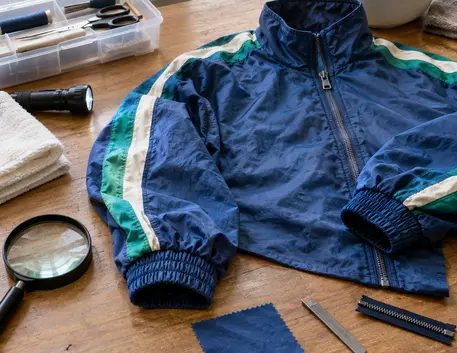
Separate cosmetic wear from structural failure before you introduce water.
Swab the Inner Hem
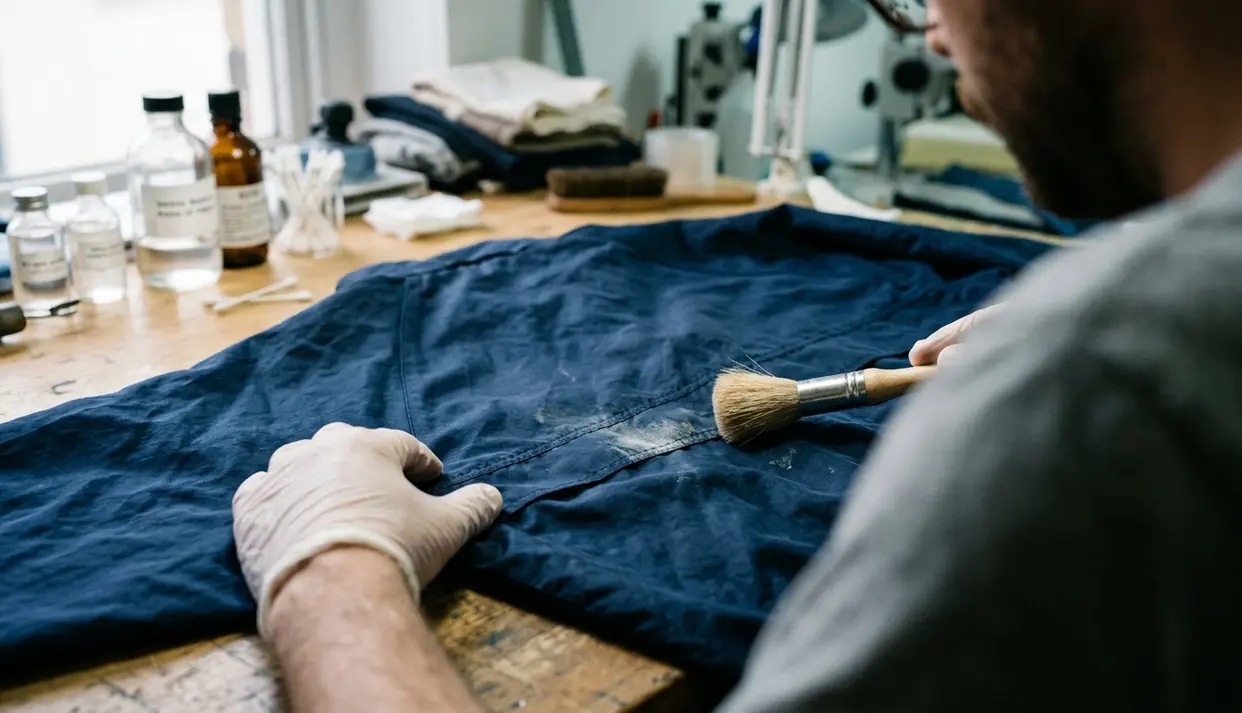
Make the first moisture a barely damp white cotton swab on an inner hem. Check the swab for dye, let the spot dry, then look for a halo. Dye on the swab, or a ring in the cloth, means you keep this jacket dry.
Cool water in the later wash still assumes that swab came back clean.
If the seam crackles in your hands, what do you think the wash will spare?
Treat the Mark, Then the Basin
The oil bloom sat under the right pocket of that green shell, a terrace snack that had waited decades. I lifted the loose residue with a dry cloth first. Dunking a dirty jacket only drives the stain through the lining.
Organic Marks Versus Oil
Work a small amount of diluted mild surfactant into an organic mark. Oil gets the same surfactant with a little more contact time. Blot. Scrubbing frays the print and drives pigment into the lining. Wait until the test area has dried without dye transfer or a ring. Then fill the basin.
Temperature in the Basin
Use water at around 20–25 °C. Hotter water can warp the synthetic weave and lock in a twisted panel you will fight for the rest of the jacket's life. Support the jacket in the basin so wet nylon does not hang from its own shoulders. Move it through the water for 3–5 minutes.
You are rinsing a weave. Save the agitation for a wool flannel overcoat.
Rinse at a similar temperature until the water runs clear of detergent.
Skip fabric softener. Its residue coats nylon fibers and holds grime and lingering odor against the weave.
Clean the mark on the table and the lining stays innocent.
Graphite on the Teeth, Air in the Bag
Clear lint from the zipper first. Then deal with oxidation on exposed metal teeth without dragging treatment onto the cloth.
Freeing Oxidized Teeth
Apply a trace of graphite to metal zipper teeth with a pencil tip and work the slider gently. If you reach for brass wax on metal hardware, shield the fabric and wipe every bit of residue away.
Drying the Blocky Line
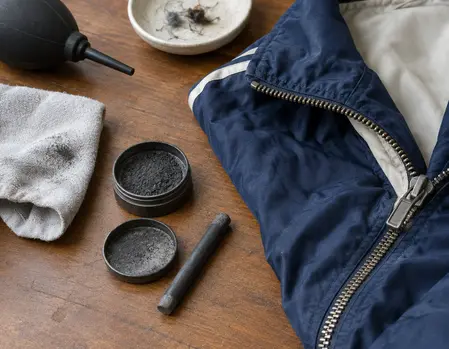
Once the jacket is clean, arrange it damp to its original wide-shouldered, blocky shape. Let it air-dry away from direct heat. Reshaping recovers that silhouette while the nylon is still pliable.
Store the piece only when the cuffs and lining are fully dry. A damp cuff in a closed bag is how dry rot gets a foothold.
- Wide padded hanger
- Breathable garment bag
- No compression in plastic
Plastic invites trapped moisture. A breathable bag reduces strain and damp. It cannot reverse deterioration already present in elastic or coatings.
Pad the Shoulders
Give the jacket a wide padded hanger and a breathable bag. Wire hangers steal the blocky line you just restored.
When Nylon Has Already Shattered
Judge the result by strength. A jacket can look fine from across a room and still be ready to split at the underarm.
After the jacket is fully dry, inspect repaired edges and high-stress points at the shoulders, underarms, and cuffs before wearing it.
A melted panel has lost its original structure. Shattered nylon may keep splitting beyond any neat patch. Conservation can stabilize a piece. It cannot make either failure into intact original fabric.
Reshaping can recover a damp track jacket's blocky outline; it cannot rebuild a melted panel or stop shattered nylon from splitting.
Is this a jacket you will wear with its damage visible, or one you will retire as an artifact?